

Candidates in France's presidential election are pushing to make themselves heard over the war in Ukraine, as polls suggest incumbent Emmanuel Macron remains the clear favourite to win.
Buoyed by his diplomacy and toughness on Moscow since its troops invaded Ukraine, he is riding high with two weeks to go before polling, but has faced accusations of ducking real debate.
Questioned on Sunday about his minimum campaigning, a testy Mr Macron told broadcaster France 3 that "no one would understand at a moment when there's war" if he was out electioneering "when decisions have to be made for our countrymen".
Short of a major upset at the April 10 first round vote, Mr Macron's opponent in the run-off will be far-right National Rally leader Marine Le Pen, in a repeat of five years ago.
But Ms Le Pen's far-right rival Eric Zemmour, conservative Valerie Pecresse and left-winger Jean-Luc Melenchon still hope they can reach the second round on April 24.
"Everything could be decided in the two weeks to come," with four in 10 likely voters still undecided, Adelaide Zulfikarpasic of the BVA Opinion polling group, told AFP.
Former columnist and TV commentator Mr Zemmour on Sunday rallied thousands of people waving French flags under a cloudless sky near the Eiffel Tower.
He urged more energy from his supporters after a speech hitting familiar notes of nostalgia for past French greatness and swipes at unassimilated immigrants.
"We've still got 14 days left; it's an eternity", Mr Zemmour said, claiming to be "the only candidate on the right".
Now trailing below 10 per cent in some polls, he is far short of Ms Le Pen's 20 per cent and Mr Macron at close to 30.
Ms Le Pen tried to project serenity as allies, including her niece Marion Marechal, deserted her for the tougher-talking Mr Zemmour.
Instead Ms Le Pen has pounded the pavements campaigning on French streets and market squares, and on Sunday again sought to cast herself as more mainstream and competent than her rival.
"Eric Zemmour's programme is brutal in form but very limited in substance, whereas I have a draft law ready to be passed" on Islam and immigration, she told weekly newspaper Le Journal du Dimanche on Sunday.
With Mr Zemmour and Ms Le Pen slogging it out for the hard-right and Mr Macron sounding pro-business and law-and-order notes, conservative Valerie Pecresse has struggled to make herself heard.
-
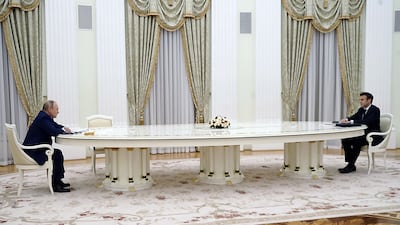
Russian President Vladimir Putin, left, and French President Emmanuel Macron meet in the Kremlin in Moscow. EPA -
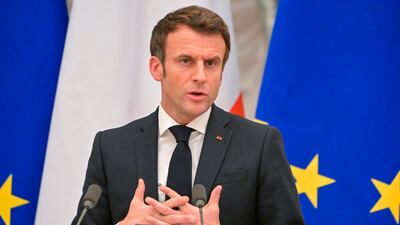
Mr Macron at a joint news conference with Mr Putin after five hours of talks. AP -

Mr Putin said proposals put forward by the French leader during their discussion could form a basis for moving forwards. The crisis was sparked by Russia's massing of troops on its border with Ukraine. EPA -
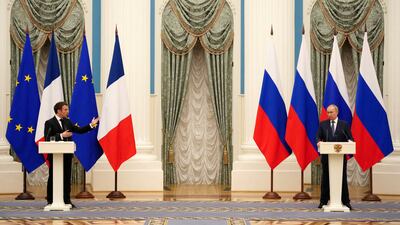
Mr Putin denied that Russia was acting aggressively towards Ukraine or the West. Reuters -

The Russian leader said Ukrainian authorities were to blame for the conflict in the east of the former Soviet state. Reuters -

Mr Macron said the discussion could "make a start in the direction in which we need to go, which is towards a de-escalation". AFP -
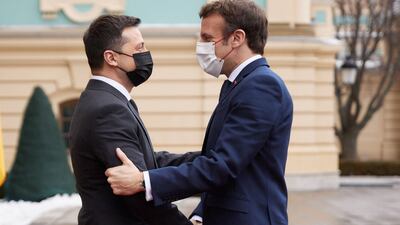
Mr Macron also travelled to Kiev to meet Ukrainian President Volodymyr Zelensky, left. AFP -
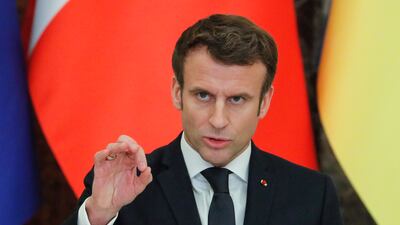
Mr Macron at a joint press conference with his Ukrainian counterpart following their meeting. EPA


Most recently, a positive Covid test has kept her from planned campaign stops.
On Sunday, the leading left-wing candidate Jean-Luc Melenchon - polling at 12 to 15 per cent - was rallying supporters in the Mediterranean port city Marseille.
While left-wing resistance including the 2018-19 "yellow vest" protest has dogged the presidency of former banker Mr Macron, a slew of competing candidacies from the left have yet to make a real mark on this year's election.
Mr Melenchon told the crowd that "we've suddenly said to ourselves 'we're going to make it'" into the second round.
"We're going to talk about serious things, not money fantasies like the one or racist fantasies like the other," he added, targeting Mr Macron and Ms Le Pen.
Left-wing voters are split between Paris Mayor Anne Hidalgo - polling around just two percent for the once-mighty Socialist Party - Communist candidate Fabien Roussel and Greens boss Yannick Jadot.
The woes of Ms Pecresse and Ms Hidalgo, candidates respectively of the traditional right and left bastions that dominated France for years, illustrate the longer-term factors beyond Ukraine that have scrambled French politics.
"The systematic voter who voted out of duty, the voter who was loyal and faithful to political parties or to candidates... no longer exists," said Anne Muxel, research director at Paris' Centre for Political Research.
"Voters have a much more independent, individualised relationship to politics and to their electoral choices, they're much more mobile, more volatile," she said.
Especially given that "the majority of French people don't feel represented by political office-holders."

